Databricks Agent
End-to-end walkthrough for onboarding a Databricks Agent via the Trusted Agent Huddle to the gallery using the AI Refinery runtime.
This walkthrough shows how to add the Databricks Agent via the Trusted Agent Huddle, upload its runtime definition, configure credentials, and run validation queries inside the Agent Gallery.
1. Create the Databricks Agent
From the Agent Gallery toolbar select Add Agent, pick the owning organisation, and fill out the metadata (identifier, display name, description, licence, and type) for the Databricks Agent.
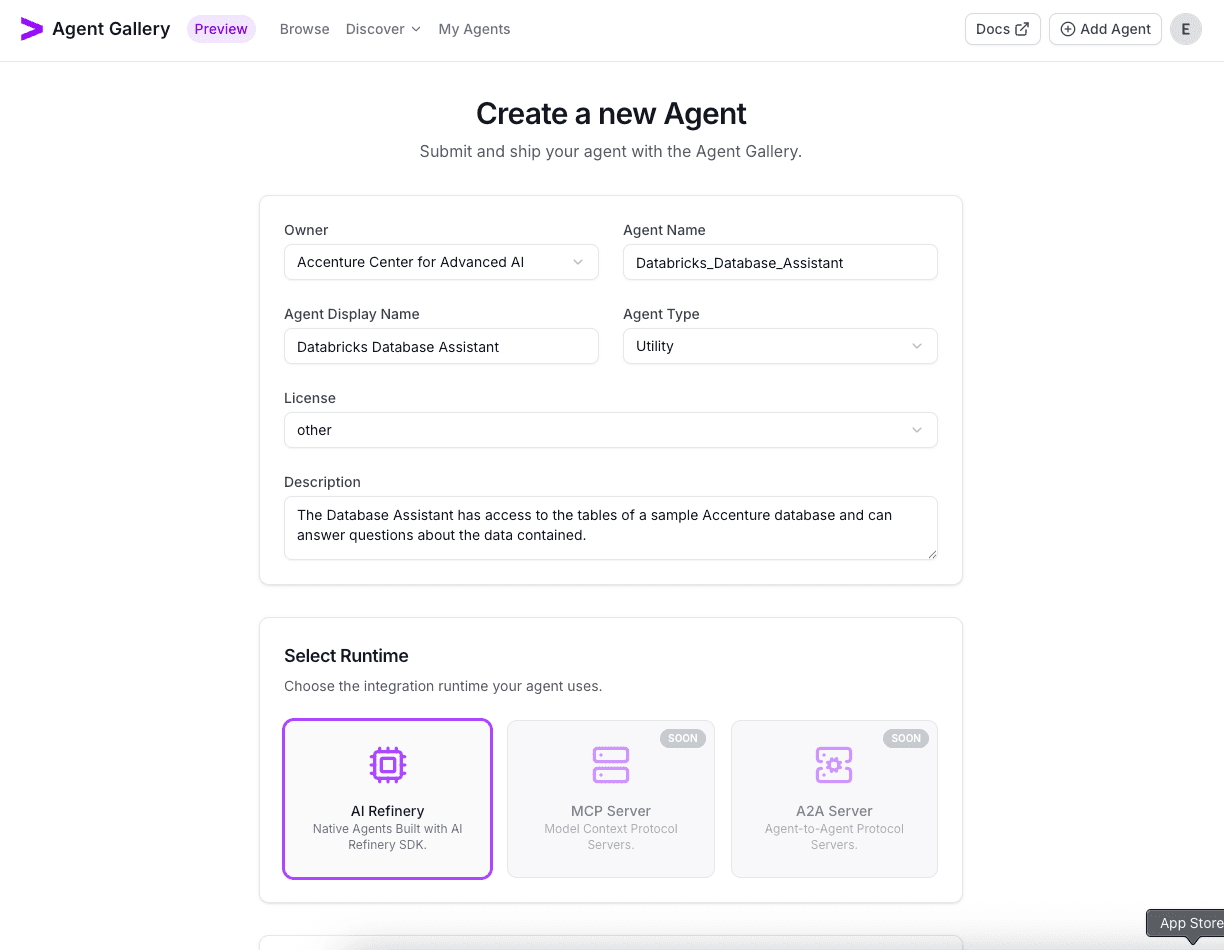
Click Create Agent to provision the new entry and advance to its overview page.
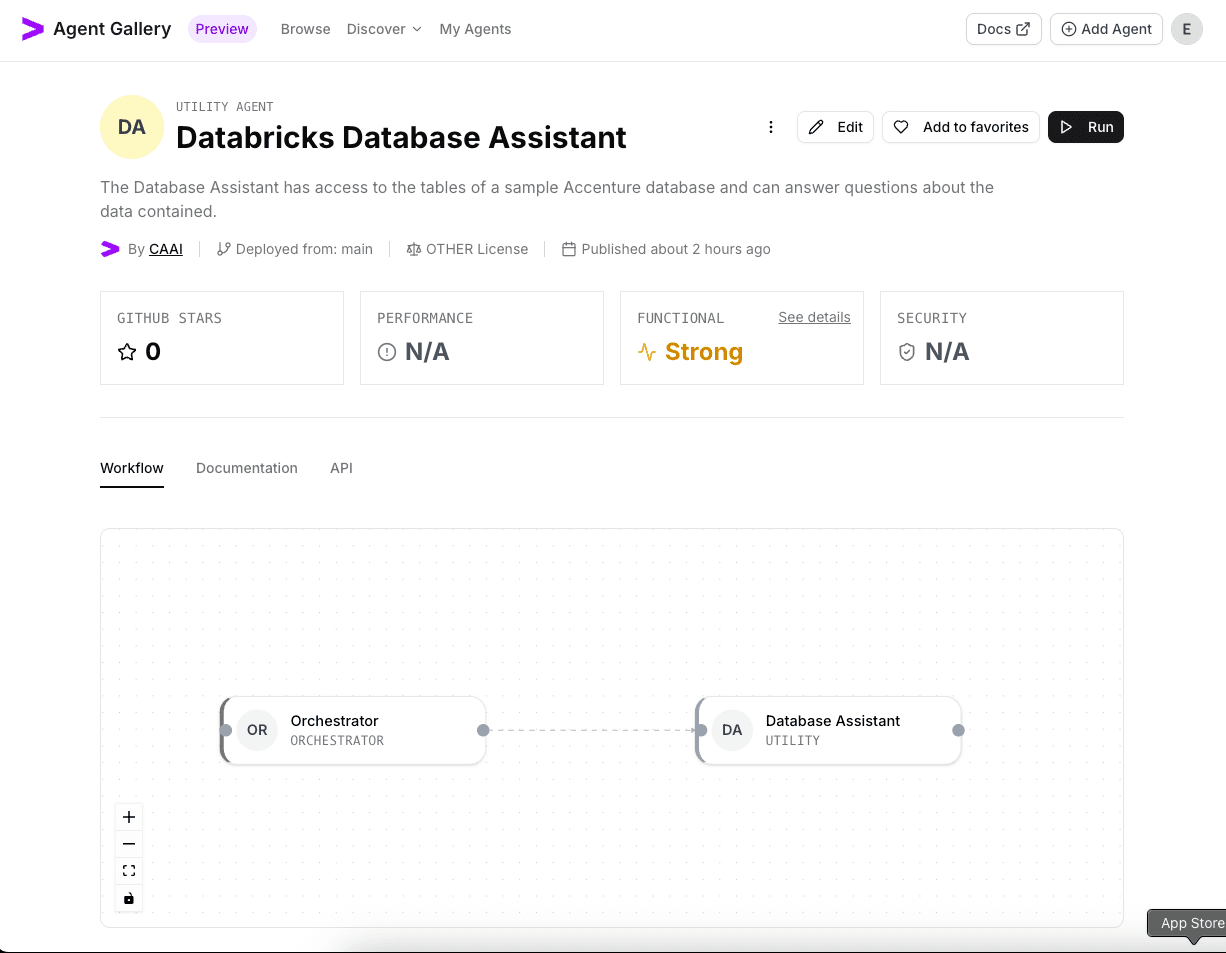
2. Upload the runtime YAML
Use Edit → Runtime, confirm the runtime type matches your Databricks integration, and upload example.yaml with the agent definition below.
orchestrator:
  agent_list:
    - agent_name: "Database Assistant"

utility_agents:
  - agent_class: DatabricksAgent
    agent_name: "Database Assistant"
    agent_description: "The Database Assistant has access to the tables of an Accenture database and can answer questions about the data contained."
    config:
      client_id: "DATABRICKS_CLIENT_ID" # Required: Environment variable holding Databricks client ID
      client_secret: "DATABRICKS_CLIENT_SECRET" # Required: Environment variable holding Databricks client secret
      host_url: "DATABRICKS_HOST" # Required: Environment variable holding Databricks host URL
      genie_space_id: "GENIE_SPACE_ID" # Required: Environment variable holding Databricks Genie space ID
      contexts: # Optional
        - "date"
        - "chat_history"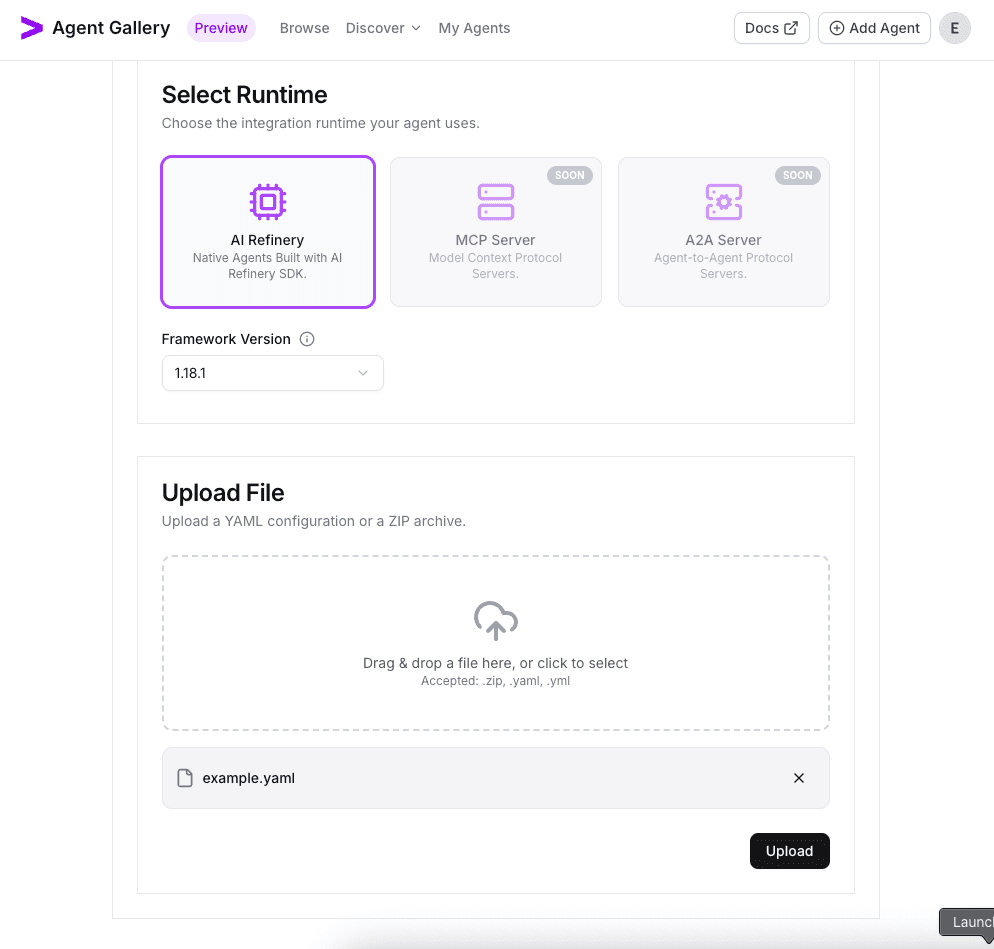
You should see in the build status that the runtime is successfully uploaded.
3. Register configuration values
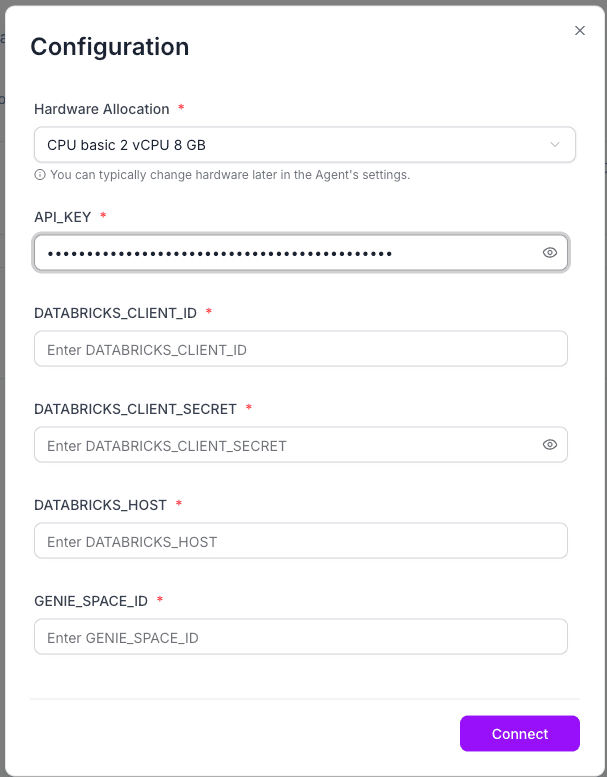
Open the Config tab, choose Add Configuration, and register each Databricks environment variable referenced in the YAML. Mark the variables as required and masked accordingly.
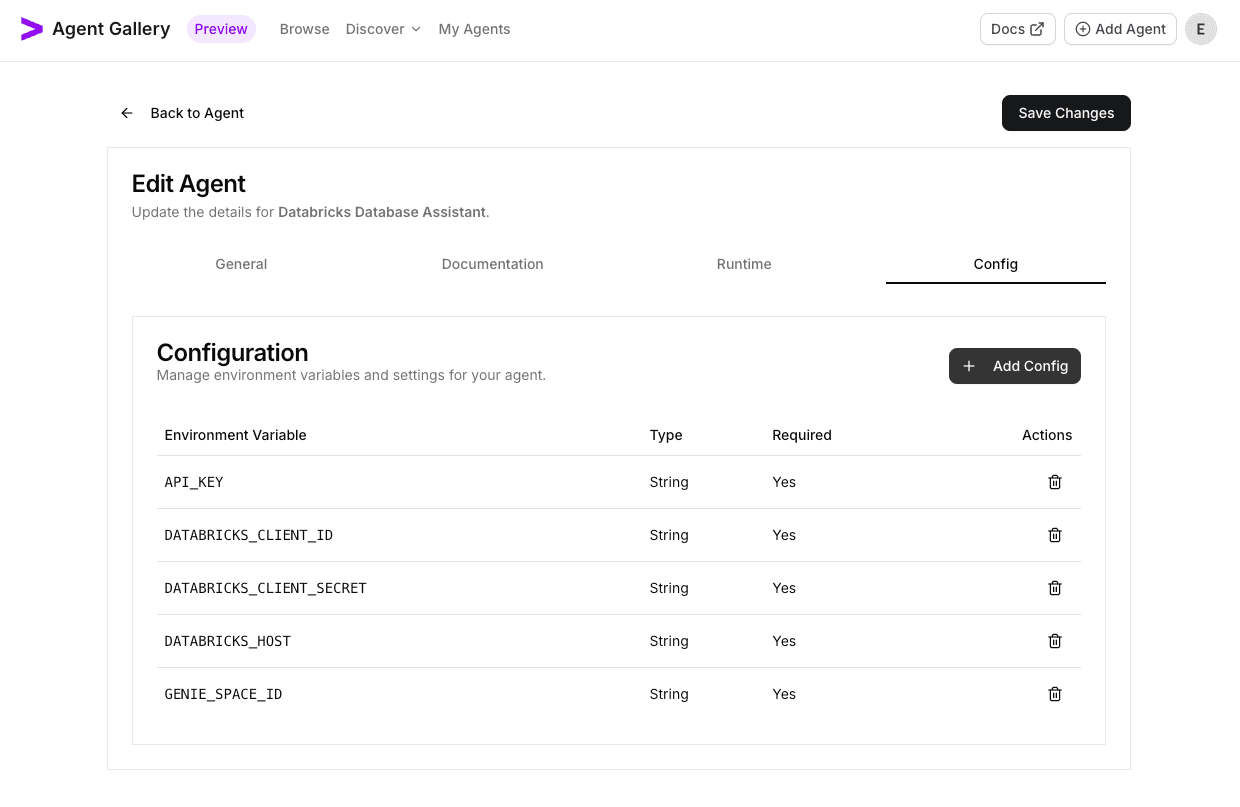
| Environment Variable | Type | Required | Description |
|---|---|---|---|
API_KEY | String | Yes | Your AI Refinery API key. |
DATABRICKS_CLIENT_ID | String | Yes | Databricks OAuth client ID referenced by the runtime configuration. |
DATABRICKS_CLIENT_SECRET | String | Yes | Databricks OAuth client secret that pairs with the client ID. |
DATABRICKS_HOST | String | Yes | Base URL of the Databricks workspace the agent connects to. |
GENIE_SPACE_ID | String | Yes | Identifier for the Databricks Genie space targeted by the agent. |
These will ask for the variables before a run.
4. Launch a validation run
Return to the agent overview and select Run. Choose the hardware preset, populate the configuration fields with valid Databricks configuration and secrets, and run the agent.
5. Issue starter queries
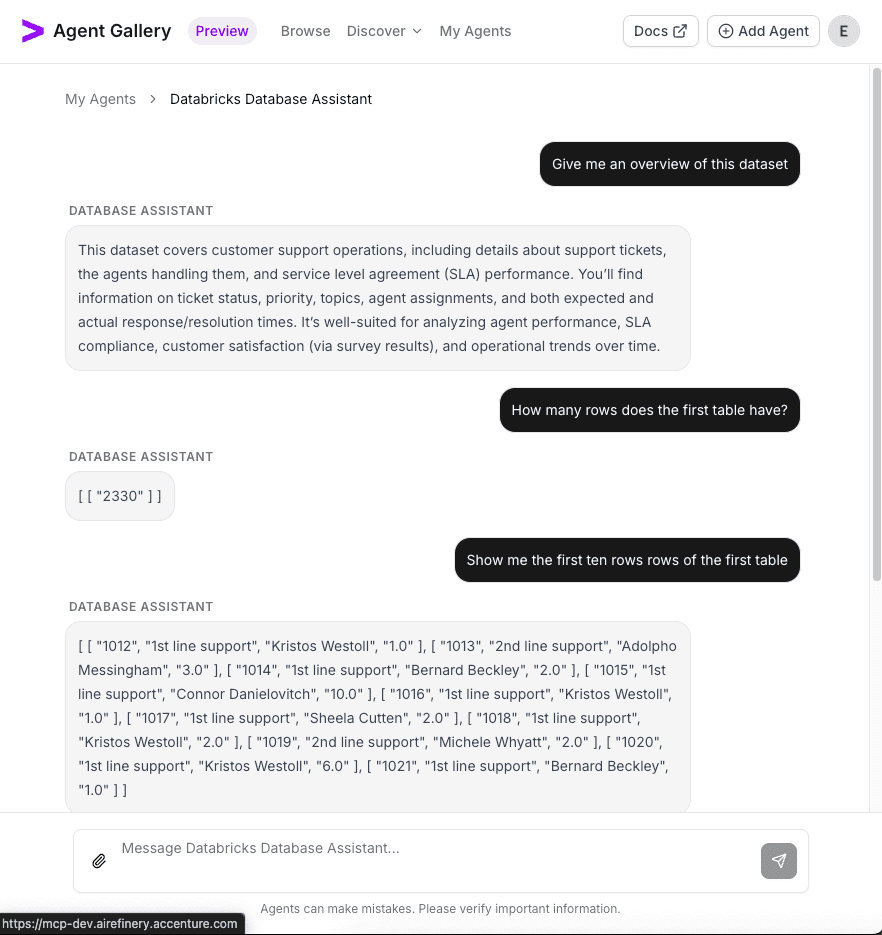
Use the chat input to ask introductory questions that verify connectivity—for example, request a table list or basic aggregation. Confirm the responses match Databricks data.
6. Try advanced analysis
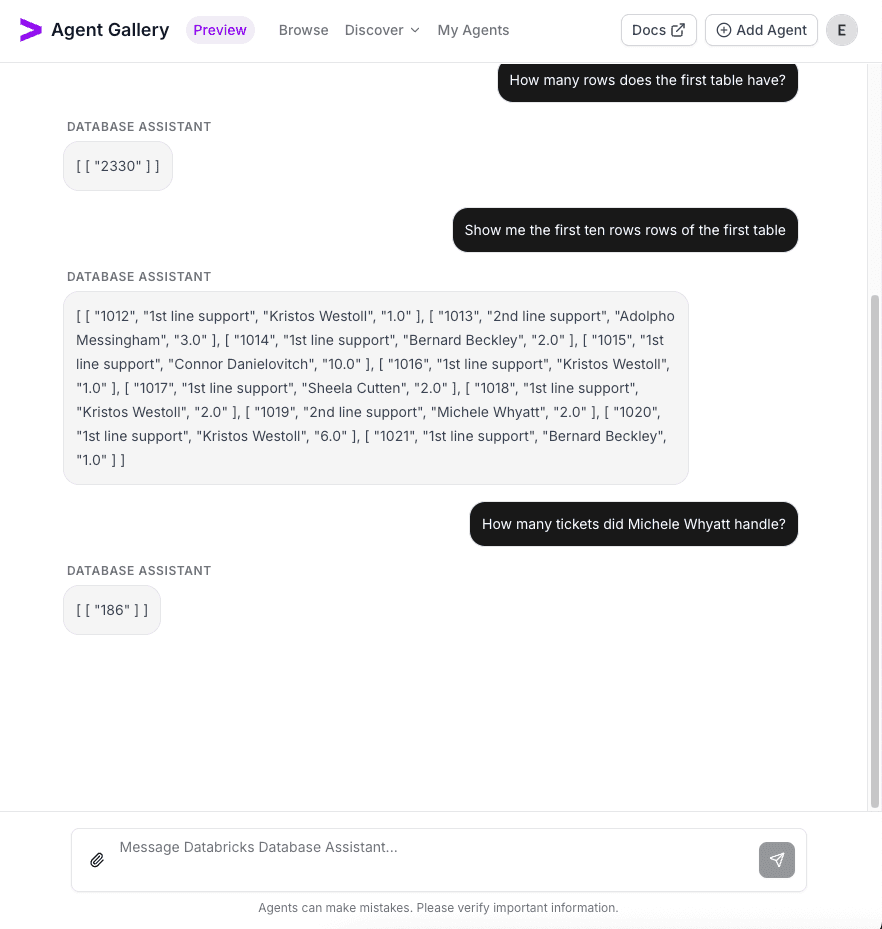
Once the agent responds to simple prompts, escalate to more complex SQL or multi-step instructions to validate orchestration behaviour and context handling.
7. Wrap up the session
When validation is complete, shut down the run to release compute resources and capture notes on any follow-up configuration changes needed for production usage.
Amazon Bedrock Agent
End-to-end walkthrough for onboarding an Amazon Bedrock Agent via the Trusted Agent Huddle to the gallery using the AI Refinery runtime.
Google Vertex Agent
End-to-end walkthrough for onboarding a Google Vertex Agent via the Trusted Agent Huddle to the gallery using the AI Refinery runtime.