Agent Maturity
Understand the AMC-5 maturity levels and certification axes covering performance, security, and functionality.
Agentic Maturity and Certification (AMC)
Purpose. Provide a unified way to see an agent’s autonomy level and trust its readiness:
- Maturity (L1→L5): how agentic it is, how much autonomy and agency.
- Certification (Performance / Security / Functional): how secure, effective, and interoperable it is.
- Technology Readiness Level (TRL1→TRL7): assessment of the market readiness of the agents for deployment.
Maturity Levels
We adopt a framework for agentic maturity, from Level 1 to Level 5, with L5 being the highest maturity. We call this the AM-5 framework - which draws inspiration from seminal work on agentic autonomy like Levels of Autonomy for AI Agents, the Agentic Identity Maturity Model and the Agentic Enterprise Maturity Model.
Hinge: From L3+, agents start to work as teams with greater autonomy.
Three Dimensions of Agent Maturity
The AM-5 framework evaluates agents across three complementary dimensions that together provide a comprehensive view of an agent's capabilities and readiness:
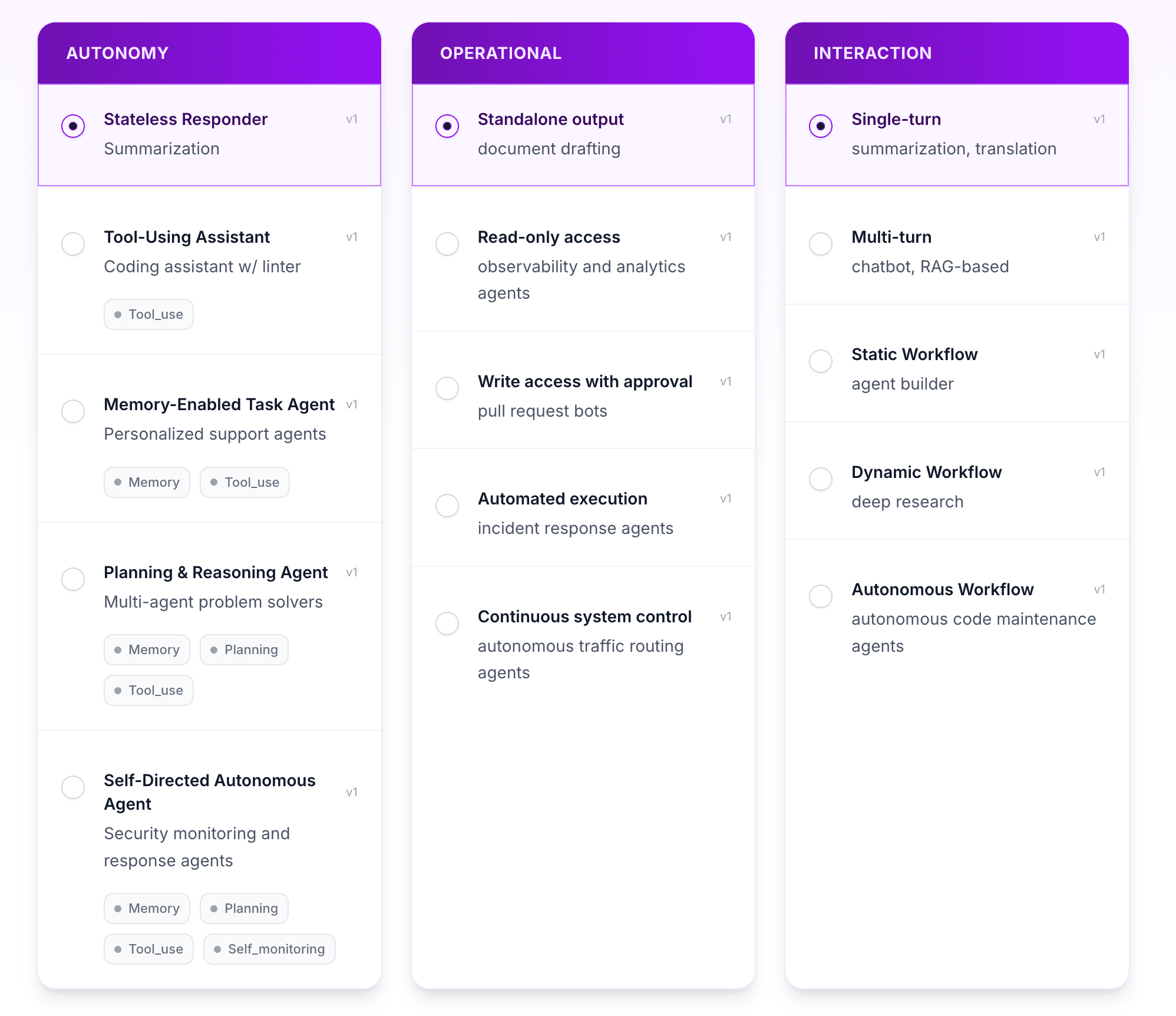
AUTONOMY measures the agent's inherent capabilities and level of independent decision-making:
- Stateless Responder: Responds without retaining past context (e.g., summarization, translation)
- Tool-Using Assistant: Uses external tools to accomplish tasks (e.g., coding assistant with linter)
- Memory-Enabled Task Agent: Combines memory and tool use for personalized support agents
- Planning & Reasoning Agent: Uses memory, planning, and tool use to act as multi-agent problem solvers
- Self-Directed Autonomous Agent: Adds self-monitoring to memory, planning, and tool use (e.g., security monitoring and response agents)
OPERATIONAL describes how the agent interacts with its environment and systems:
- Standalone output: Agents produce output independently (e.g., document drafting) without system integration
- Read-only access: Agents observe and analyze data from systems (e.g., observability and analytics agents)
- Write access with approval: Agents perform actions requiring human oversight (e.g., pull request bots)
- Automated execution: Agents execute actions without direct human approval per step (e.g., incident response agents)
- Continuous system control: Agents provide autonomous traffic routing and continuous system management without human intervention
INTERACTION outlines the complexity of user interaction and workflow management:
- Single-turn: Simple, one-off interactions (e.g., summarization, translation)
- Multi-turn: Conversational, multi-exchange interactions (e.g., chatbot, RAG-based)
- Static Workflow: Follows predefined agent-builder workflows
- Dynamic Workflow: Adapts to complex tasks (e.g., deep research)
- Autonomous Workflow: Manages long-running, self-directed workflows (e.g., autonomous code maintenance agents)
An agent's maturity level (L1-L5) reflects its position across all three dimensions, with higher levels indicating greater autonomy, operational capability, and interaction sophistication.
Agent Maturity Questionnaire
To determine the AM-5 maturity level for agents in the gallery, we apply a questionnaire to each agent based on its metadata. The questionnaire is executed by a frontier model and composed into a rubric for LLM-as-a-judge classification.
The questions probe three aspects aligned with the maturity dimensions: Interaction (user engagement pattern), Autonomy (decision-making independence), and Scope (work complexity and adaptability).
Level 1: User as Operator, Agents as Task Executors
This level is defined by direct command and single-purpose execution. The agent is a simple tool.
- Interaction: Does the user provide an explicit, step-by-step instruction for a single, predefined task (e.g., "summarize this text," "translate this sentence")?
Answer Options: Yes / No
- Autonomy: Does the agent operate without any independent decision-making, strictly following a fixed script or a rigid set of rules?
Answer Options: Yes / No
- Scope: Is the agent's functionality limited to a narrow, singular purpose, unable to chain commands or handle ambiguity?
Answer Options: Yes / No
Level 2: User as Collaborator, Agents as Trustworthy Assistants
This level involves delegating a complete but contained task that may require multiple steps. The agent is a reliable helper.
- Interaction: Can the user delegate a complete, but well-defined, multi-step task (e.g., "research topic X and comparing the outputs given by Gemini, Claude, OpenAI and Perplexity") and expect a finished product?
Answer Options: Yes / No
- Autonomy: Does the agent require human supervision or intervention to handle exceptions, confirm intermediate steps, or resolve ambiguities?
Answer Options: Yes / No
- Scope: Can the agent reliably execute a sequence of related actions to fulfill a single, delegated outcome?
Answer Options: Yes / No
Level 3: User as Consultant, Agents as Team Players
This is the hinge level where multiple agents begin working together. The focus is on coordination and workflows.
- Interaction: Does the user provide a goal to a system of agents, which then coordinate amongst themselves to achieve it, with the user acting as a consultant?
Answer Options: Yes / No
- Autonomy & Collaboration: Do multiple agents communicate and pass information between each other to complete a workflow without direct, step-by-step user management?
Answer Options: Yes / No
- Scope & Complexity: Does the system involve specialized agents with distinct roles or "identities" that contribute to a larger, orchestrated process (e.g. agents within a super, utility agent hierachy each with defined tasks like a Market Research Utility Agent reporting to a Sourcing Intelligence Super Agent)?
Answer Options: Yes / No
Level 4: User as Approver, Agents as Goal-Driven Professionals
At this level, agents become proactive planners. The user's primary role shifts from director to approver.
- Interaction: Is the user's main role to approve or reject a multi-step plan that was autonomously generated by the agent(s) in response to a high-level goal?
Answer Options: Yes / No
- Autonomy: Does the agent independently devise its own strategy, create novel sub-tasks, and sequence actions to achieve the user's abstract objective?
Answer Options: Yes / No
- Scope & Adaptability: Can the agent incorporate feedback to dynamically refine its plan before or during execution, demonstrating a professional, goal-driven approach?
Answer Options: Yes / No
Level 5: User as Observer, Agents as Autonomous Workers
This is the highest level of maturity, where agents function like self-sufficient digital employees.
- Interaction: Does the user primarily observe the agent's performance against high-level, long-running objectives, rather than managing individual tasks or plans?
Answer Options: Yes / No
- Autonomy: Does the agent operate with full autonomy, managing its own resources, workflows, and long-term strategy to achieve business-level outcomes?
Answer Options: Yes / No
- Scope & Adaptability: Does the agent proactively optimize its own performance and strategies over time based on outcomes, without requiring explicit human guidance for improvement?
Answer Options: Yes / No
Agentic Certification Mapping
The AMC-5 framework combines maturity levels (L1-L5) with certification axes (Performance, Security, Functionality) to provide a comprehensive assessment. The certification requirements scale with maturity level, reflecting the increased responsibility and complexity at higher autonomy levels.
| Level | Performance Certification | Security Certification | Functionality / Interoperability |
|---|---|---|---|
| L1 Narrow Task | Correctness metrics prioritized. Human ensures robustness and reliability (e.g., copilot). | Human-centric interaction, audit, and moderate security required. | Not required. |
| L2 Multi-Task | Correctness metrics prioritized. Human ensures robustness and reliability (e.g., copilot). | Human-centric interaction, audit, and moderate security required. | Basic – works with orchestrator / models. |
| L3 Pre-Coordinated | All correctness and robustness metrics prioritized as agents run autonomously for multiple turns. | Semi-autonomous, moderate security and audit required. | Moderate – works with other agents. |
| L4 Dynamic Planning | All correctness and robustness metrics prioritized as agents run autonomously for multiple turns. | Semi-autonomous, moderate security and audit required. | Strong – composable. |
| L5 Fully Autonomous | All correctness and robustness metrics prioritized as agents run autonomously for multiple turns. | Fully autonomous — strong security controls and audit required. | Excellent – well-defined and highly composable. |
Technology Readiness Level (TRL)
The Technology Readiness Level (TRL) framework gauges how close an agent is to real-world deployment, focusing on its technical robustness, operational environment, and regulatory readiness. Our 7-tier adaptation tracks the progression from initial concepting through highly regulated production usage.
| Level | Tier | Description | Typical Activities / Deployment Context |
|---|---|---|---|
| Level 1 | Concept & Roadmap Tier | Agent requirements and functionalities conceptualized and validated for business outcomes. | Process re-engineering, functional due diligence. |
| Level 2 | Prototype Tier | Working standalone agent prototypes validated for intended functionality and outcomes with mostly synthetic data. | Simple internal demos, proof-of-concept builds. |
| Level 3 | Trusted Agent Huddle Tier | Working agent prototypes onboarded to AI refinery and enabled for trusted agent huddle orchestration across systems. | Hackathons, cross-functional demos, proof-of-concepts, citizen / power-user experiments. |
| Level 4 | Pilot Tier | Working agents with full functionality and limited robustness in a real-life workflow tuned to perform with production data. | COE teams, production rollout for pilot user groups and scale to get feedback and improve. |
| Level 5 | Production Tier - General Usage | Working agents that are deployed and operating in general purpose internal facing scaled production usage. | Startups, less-regulated internal business functions or production pilots. |
| Level 6 | Production Tier - Customer Usage | Working agents with high functionality, performance, tuning, controls for customer facing scaled production usage. | Customer facing business functions or production pilots. |
| Level 7 | Production Tier - Regulatory Usage | Working agents with high functionality, performance, tuning, regulatory level controls for customer facing scaled production usage. | Highly regulated financial, healthcare, federal production systems. |
In essence: TRL reflects market and deployment readiness, complementing Maturity (how autonomous it is) and Certification (how trustworthy it is) to give a full picture of an agent’s lifecycle.
AMC-5 Certificate Card
Below is an example of an in-development AMC-5 report / certificate. The agent maturity level is determined via LLM-as-a-Judge execution of the AM-5 questionnaire. Certification details are available on the certification page.
| Category | Assessment based on L3 Certification |
|---|---|
| Maturity - Interaction | Yes — The user provides a goal in the investment research task to the "Investment Strategy Advisor". |
| Maturity - Autonomy | Yes — The multiple agents communicate and pass information between each other using a FlowSuperAgent. |
| Maturity - Scope | Yes — The agent has clear, specialized roles defined like "Stock Price Researcher" and "Financial Report Writer" within an agent hierarchy with "Investment Strategy Advisor" and is part of a coordinated process using a FlowSuperAgent. |
| Technology Readiness Level | Level 3 – Trusted Agent Huddle Tier — Built as an example for utilising the FlowSuperAgent within the AI Refinery and deployed within experimentation environments. |
| Certification - Performance | Pass — The agent meets the required standards for tool selection, invocation correctness, reliability, and latency. |
| Certification - Functionality | Excellent — The agent demonstrates high capability in interoperability, composability, documentation, and guardrails. |
| Certification - Security | A (Minimal Risk) — The agent has the highest security grade, assessed on factors like CIA impact and likelihood. |
Agentic Maturity & Certification (AMC-5)
This certifies the agent’s maturity level and the results across Performance, Security, and Functional readiness.
Agent prototypes orchestrated across systems within the AI refinery and trusted huddles.
Tool selection · Invocation correctness · Reliability · Latency
Impact × Likelihood on CIA · Identity · Audit · Zero-Trust
Interop (AIR/MCP/A2A) · Composability · Docs · Guardrails
Gallery AMC-5 Schema
This is an in-development schema for the AMC type of certification and maturity from the gallery.
{
  "agent_id": "CAAI/Investment_Strategy_Advisor",
  "maturity_level": 3,
  "cert": {
    "performance": "pass",
    "security_grade": "A",
    "functional": "excellent"
  },
  "telemetry": {
    "tool_selection_acc": 0.94,
    "valid_invocation_rate": 0.98,
    "success_rate": 0.97,
    "latency_p95_ms": 2100
  },
  "security": {
    "impact": "medium",
    "likelihood": "low",
    "controls": ["scoped OAuth", "audit sink"]
  }
}